
By VOW Co-Chair Hannah Hadikin
It is hard to believe that half the year has already passed. After weeks of abundant rain, the sun has returned generously, bringing what some might call a true summer scorcher.
Across the region, farmers’ markets are setting up their stalls with delicious fruit, seasonal vegetables, homemade cold drinks, fresh baked goods, and, of course, divine ice cream. These local gatherings remind us of the simple joy that comes from food, community, and spending time together.
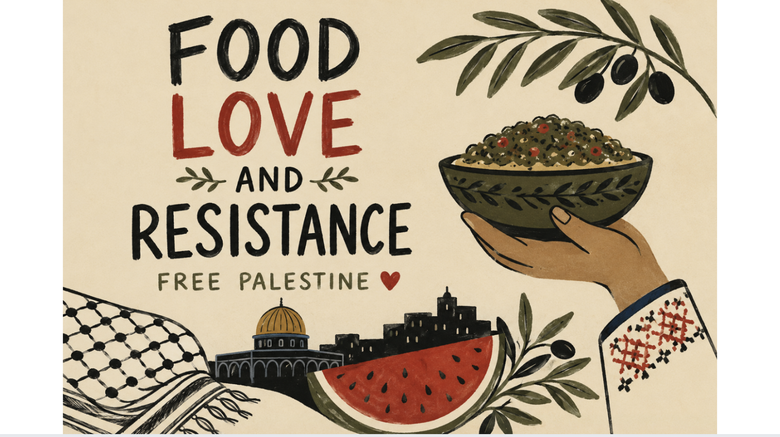
That spirit was very much present at a special early-evening event hosted by Nelson4Palestine: Food, Love and Resistance, featuring Palestinian chef Izzeldin Bukhari. The dinner offered a memorable opportunity to experience Palestinian culture through food. It was also grounded in the history of Palestinian resistance, the realities of life under occupation, and the continuing struggle for a free and just Palestine.
Chef Izzeldin shared how deeply moved he was by the people he met in Nelson. He spoke of the community’s positive energy, leadership, passion, organization, genuine concern, and warmth. A heartfelt thank-you went to everyone who helped make the beautiful gathering possible. It was a major undertaking, supported by many volunteers from across the community, including people connected to the Nelson Community Food Centre, Nelson United Church, the Lutheran Church, and First Baptist Church.
Every contribution mattered, from preparing and serving the food to providing bowls, teapots, bread baskets, spoons, with countless items needed to welcome guests around the table. Reminding me of our Doukhobor gatherings and events, with offerings of food.
Musicians Ryann, Tenise Marie, and Louis Bockner captured the spirit of the evening beautifully through their music. The funds raised will help alleviate some of the suffering that continues in Gaza and throughout Palestine. Financial support matters, but so does sustained public action. We must continue pressing every level of government to end economic, military, and political support for policies that contribute to the destruction, displacement, and suffering of the Palestinian people. Gathering together we stand firmly and remain committed to working toward a free and just Palestine, while keeping hope alive.
The arrival of computers, the internet, smartphones, and social media has transformed how we communicate. We can now connect instantly with people in almost every part of the world. Through those connections, we often discover that we have far more in common than we may have imagined. Across cultures, languages, and borders, many people share the same deep desire for peace, dignity, safety, and harmony.
Technology across continents, however, has a darker side. News and information can travel quickly, but so can false claims, misleading headlines, manipulated images, selective reporting, and deliberate misinformation. Social media algorithms often reward the loudest or most emotionally charged content, rather than the most accurate or responsible reporting.
At the same time, enormous private wealth is being used to influence the media. Billionaires and powerful corporations can purchase newspapers, television networks, magazines, and digital platforms, giving a small number of people tremendous control over the information the public receives. This is not happening only in the United States. Media freedom organizations, including Reporters Without Borders and the Media Freedom Rapid Response, have raised concerns about the increasing concentration of media ownership in France and elsewhere. When a small number of industrial groups control much of a country’s media landscape, owners may gain direct or indirect influence over newsroom priorities, editorial decisions, and the political ideas that receive the most attention.
Independent journalism is essential to a healthy society. Without it, powerful interests can shape public understanding, silence criticism, and turn complex human stories into simple and misleading narratives. These concerns also lead us to the film and entertainment industries. Film is not simply entertainment. It may shape how we see the world and how we understand people whose cultures, religions, histories, and experiences differ from our own. A film can create empathy and bring people together, but it can also reinforce stereotypes, erase important context, or treat entire communities without dignity or respect.
What moral and ethical responsibilities should filmmakers, producers, distributors, festivals, and cultural organizations follow? Who makes the decisions about which stories are told, whose voices are heard, and how communities are represented? When an event, film or production dismisses the concerns of cultural communities, faith communities, or people directly affected by the subject matter, we should be willing and have the opportunity to ask difficult questions. Were those communities consulted? Were their concerns taken seriously? Was the desire to attract attention or generate profit placed ahead of respect and responsibility?
The contrast with the Nelson4Palestine gathering is striking. Food, Love and Resistance brought people together through hospitality, culture, listening, music, and shared purpose. It demonstrated that meaningful gatherings do not have to divide or diminish people. They can educate, honour lived experience, build relationships, strengthen our commitment to peace, justice, disarm and a nuclear-weapon-free world.
Whether we are consuming news, watching a film, scrolling through social media, or attending a public event, we must continue asking: Who is telling this story? Whose perspective is missing? Who benefits from the way it is being presented? Is it bringing us closer to truth and understanding, or pushing us further apart?
These questions matter. The stories we tell, support, and share help shape the kind of community, and the kind of world, we create.