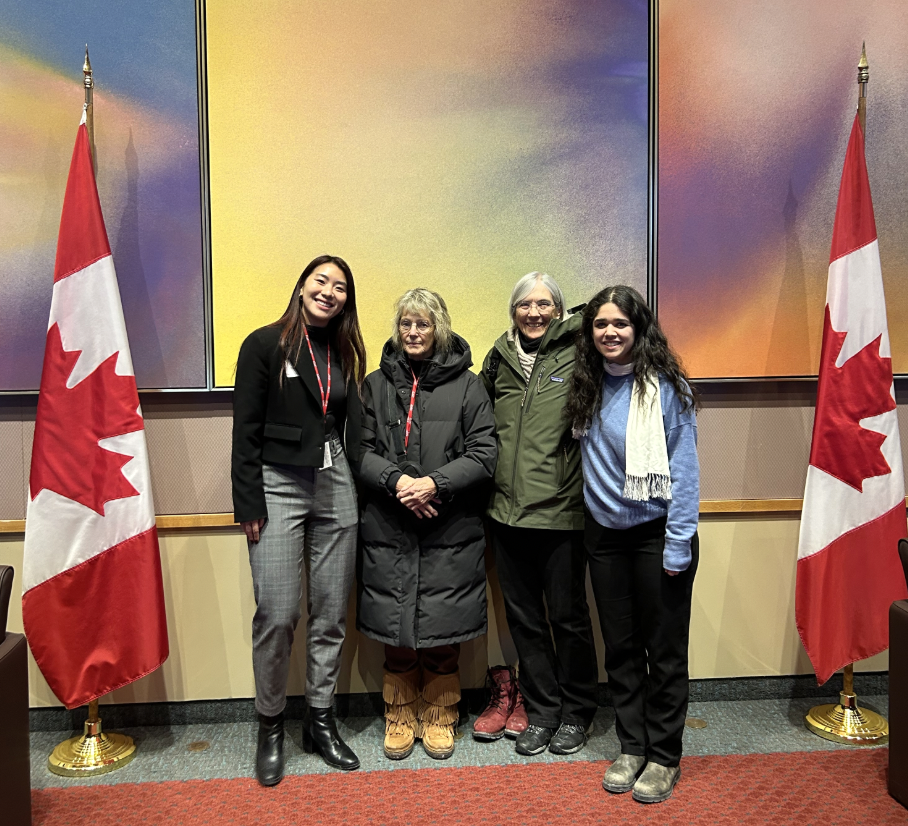
Pictured from left to right: Marissa Hum, Marney Eisenbarth-Cuff, Nancy Covington, Lia Holla
The Canadian Voice of Women for Peace (VOW) participated in the recent Civil Society Consultations on Disarmament, Non-proliferation, Arms Control, and Space convened by Global Affairs Canada. Representing VOW were Alley McDonald, VOW National Coordinator, and Lia Holla, VOW Member and Representative.
During the consultations, VOW raised pressing concerns regarding the Government of Canada’s plan to dedicate 5% of Canada’s GDP to military spending. VOW emphasized the need for a comprehensive foreign policy review to ensure alignment with Canada’s long-standing commitments to peacebuilding, multilateralism, and international law.
VOW further underscored the urgent need to strengthen and invest in disarmament education as a cornerstone of sustainable peace. Representatives called for continuity and coherence across diplomacy, disarmament, and security policy, noting that fragmented approaches risk undermining Canada’s credibility and effectiveness on the global stage. Meaningful funding for civil society organizations and delegates was also highlighted as essential to ensuring diverse, informed, and community-rooted perspectives inform national and international policy conversations.
Grounded in its longstanding commitment to feminist peace principles, VOW advocated for the consistent use of feminist language and the implementation of a robust feminist foreign policy framework—one that centers human security, gender justice, and the leadership of women and gender-diverse peacebuilders.
Alley McDonald’s full remarks from the consultation are shared below:
As Canada considers raising military spending from 2% to 5% of GDP, there remains a critical gap: a comprehensive foreign policy review. Overdue, as it has been more than 21 years since the last, this would provide the transparent, whole-of-government review needed for clear direction in our principals, values and intent, and strategic clarity to make informed decisions grounded in common security principles.
A full review would identify where security investments are most effective, prioritizing diplomacy, disarmament, and conflict prevention over reactive defence spending, and ensuring resources are used sustainably and equitably.
By embedding security within the pillars of the Women, Peace and Security agenda: such as the participation of women in decision-making, prevention of conflict and violence, protection of women’s rights, and relief and recovery that is gender-responsive, Canada can meet the root causes of insecurity at home and abroad grounded in an evidence-based approach towards peace.
Without an explicit foreign policy review, the gap between Canada’s stated values and its actions will continue to widen, undermining our credibility and integrity on the global stage. A comprehensive foreign policy review is essential to ensure Canada’s international engagement and work in nuclear disarmament is coherent, accountable, and responsive to today’s international realities.
Thank you.
Alley McDonald, National Coordinator, Canadian Voice of Women for Peace
Alley is a dedicated peace practitioner and a graduate of the Master’s of Peace and Conflict Studies program at the University of Waterloo. She currently serves as the National Coordinator of the Canadian Voice of Women for Peace, and engaged with IPPNWC in our Disarmament Education Program. Alley is also a restorative justice practitioner – working as a mediator and conflict coach in community. She works with both youth and adults navigating the criminal legal system, supporting transformative approaches to justice and conflict resolution.
Lia Holla, Consultant, Canadian Voice of Women for Peace
IPPNW-C; Women’s Peace and Security Network, McGill
Lia Holla is a young professional in peace and disarmament who has been working and volunteering on policy, education, and advocacy with community, national, and international NGOs, since 2014. Her approach has been shaped by experiences such as participating in a 200 km peace walk led by Indigenous grassroots grandmothers, studying physics and political science at McGill University, and 5 years serving as lead staff member of the International Physicians for the Prevention of Nuclear War Canada (IPPNWC) as Executive Director. Her current work focuses on advancing disarmament education for students, secondary school teachers’ unions, the general public, and parliamentarians in Canada. She was recognized as one of 25 global leaders under the age of 29 by the United Nations Office for Disarmament Affairs (UNODA) and named a “Leader for Tomorrow and into the Future.” She has also participated in two years of UNODA’s Youth4Disarmament training programs and represented the cohort at UN meetings.
Marney (Margaret) Cuff, Board Member, IPPNW-CANADA
Canadian Voice of Women for Peace
Marney Cuff-Eisenbarth, MRT-R; MSW – Social Policy/Indigenous Peoples Policy; ecological farmer. Marney studied radiation biology at McMaster University in the 1970s when the only data in this realm of study arose from the Hiroshima and Nagasaki experience – from that point on she has been deeply interested, and concerned, with all in the realm of “nuclear”. Marney’s other passion is in the realm of social justice and thus she returned to post-secondary to gain knowledge and skills in social movements/social change, community organizing, in particular in the realm of Indigenous Peoples Policies and rights. Recall, Indigenous Peoples in Canada, and around the globe, are disproportionately impacted by nuclear weapons/testing/uranium mining/nuclear waste.
Marissa Hum, Board Member, International Physicians for the Prevention of Nuclear War Canada
Canadian Network to Abolish Nuclear Weapons
Canadian Voice of Women for Peace Member
Marissa currently sits on the Board of Directors of the International Physicians for the Prevention of Nuclear War Canada and on the Steering Committee for the Canadian Network to Abolish Nuclear Weapons. While attending the University of California, Berkeley in 2016, Marissa studied International Relations and International Law with a focus on the nuclear weapons crisis. Marissa became a member of Canadian Voice of Women for Peace (VOW) in 2018 and attended the United Nations Commission on the Status of Women in 2019 and 2024 as a member of VOW. She also attended the TPNW 3MSP in 2025. Marissa’s perspective on nuclear disarmament has taken an international law lens that focuses on the intersection between human rights, international law, and international relations.